Europe's Pet Market 2025
Europe is among the world's most stable and dynamic markets for pet food. Recent data from the European pet food industry organization FEDIAF shows that pets have become a central part of many households – and thus an increasingly important economic factor.
The European Pet Market at a Glance
Around 299 million pets live in Europe, of which approximately 282 million do not have aquariums. At the same time, 49% of households own at least one pet.
These figures demonstrate that pets are no longer a niche topic, but rather a part of everyday life.
For the industry, this means one thing above all: the market is growing not only due to increasing numbers of pets, but primarily due to rising spending per pet.
The European pet food market now has a volume of over €29 billion, with growth of around 9%.
This growth is particularly noteworthy given the challenging economic environment. It suggests that pets are increasingly perceived as family members – a trend often described as the humanization of the pet.
Distribution of Pets in Europe
The European pet market is dominated by a few large countries.
The five most important markets are:
- Germany
- France
- Italy
- United Kingdom
- Spain
These countries account for the largest share of the European pet population.
In Europa live around:
- 108 million cats
- 90 millionen dogs
Cats are thus the most common pets in terms of numbers.
Economically, however, both species are similarly important: dogs dominate in terms of food volume, while cats generate an almost equally high share of sales.
This is mainly because cat owners often opt for premium and specialty products.

Dogs in Europe
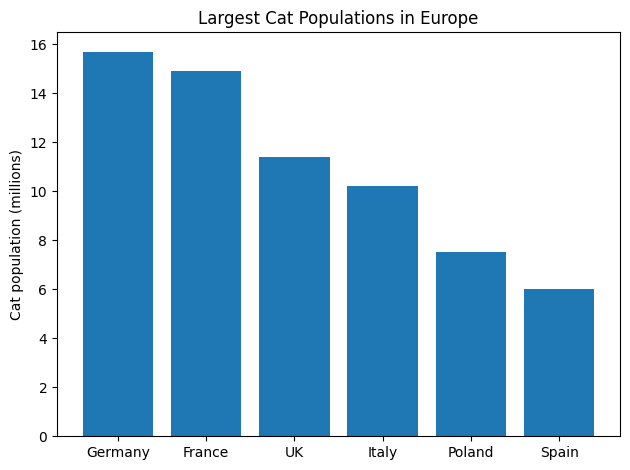
Cats in Europe
This development is particularly relevant for the supplementary pet food industry. Cats are traditionally considered a more challenging target group, but they show a high affinity for functional products – for example, for stress reduction, coat health, or urinary tract health.
Premiumization as a Key Growth Driver
A look at the pet food structure shows that the market is becoming increasingly differentiated.
In the dog food market, dry products dominate by volume, while wet food and snacks achieve a higher value share.
For cats, however, wet food represents the largest share of sales.
This development reveals two trends:
- Pet owners are paying more attention to quality and function.
- Products with added benefits are growing at an above-average rate.
This is shifting the market from pure nutrition to functional animal health.
Implications for the pet food industry:
- Pets are increasingly viewed as family members: This development is leading to increased spending per animal and greater demand for health products.
- Premiumization is replacing volume growth: In many Western markets, the number of pets is only growing moderately. Market growth is primarily driven by higher-quality products.
- Differentiation is becoming crucial: Standard pet food is becoming increasingly interchangeable.
Added value is created through: functional ingredients, sustainability, transparency, and scientific rigor.
Conclusion: Europe is developing into a health market for pets.
The European pet market is no longer growing solely due to increasing pet numbers, but also due to the rising expectations of pet owners.
The data clearly shows:
- Pets are becoming emotionally more important
- Nutrition is becoming more functional
- Health is becoming a key purchasing factor
This is an ideal environment for manufacturers of supplementary pet food.
The market is increasingly moving towards preventative animal health rather than simply feeding.
Our products
We can offer you several pet foods and feed additives. Please browse our website or contact us at petfood@plants2market.com
We look forward to hearing from you.
Source
https://europeanpetfood.org/wp-content/uploads/2025/06/FEDIAF-Facts-Figures-2025.pdf
Disclaimer
For legal reasons, we would like to point out that some of the above statements require further research and studies to scientifically prove them. Therefore, not all statements can currently be accepted by conventional medicine.
The information contained in this article regarding legal regulations, approvals, and possible uses of raw materials is based on careful research and our current state of knowledge (as of July 2025). However, we assume no liability for the completeness, accuracy, or timeliness of the information.
The legal framework for food and food supplements is subject to constant change. Therefore, the manufacturer or distributor is always responsible for checking the applicable regulations, EU regulations, and approval lists for the use of raw materials and health-related claims.
In case of legal uncertainty, we recommend consulting legal experts or the relevant authorities.